


Since 2009, Huntly Development Trust (HDT) has been working with others to make our community a better place to live, work and visit. This includes delivering projects like Number 30, Greenmyres and the Huntly Travel Hub.
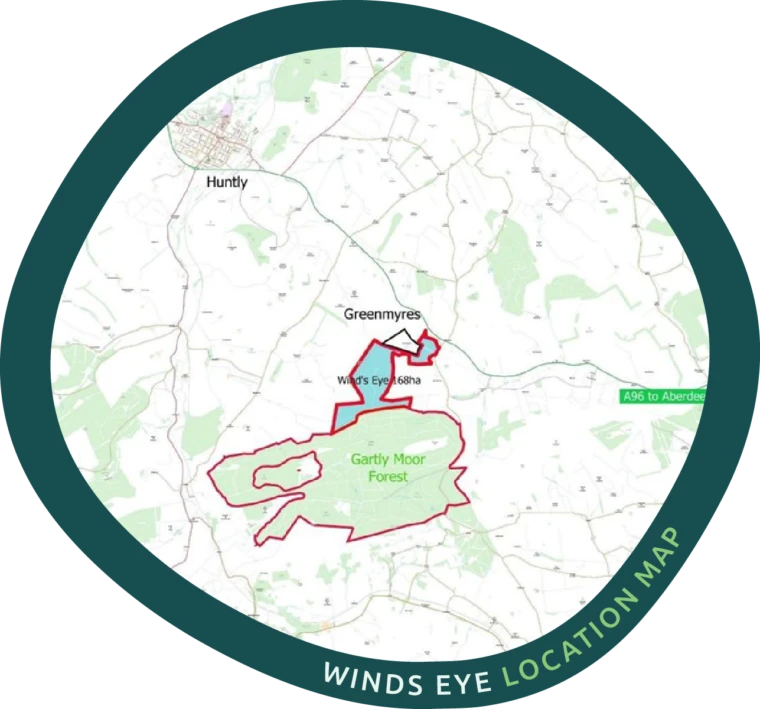
We are now proposing our next exciting step - buying Wind’s Eye, the 168-hectare (415 acre) section of Gartly Forest (GF) right next to our Greenmyres venue. Please read on to find out why and how we want to do this, what it could mean for Huntly and District, and how you can give your feedback on the proposal. This is a genuinely transformational opportunity for our area - please take the chance to give us your views.


Project Information

Wind’s Eye & why HDT is proposing to buy it
More: Wind’s Eye & why HDT is proposing to buy it
The benefits on offer
More: The benefits on offer
Governance & management
More: Governance & management
Purchase price & financing
More: Purchase price & financing
Risks & concerns
More: Risks & concernsProject Documents
- View document
Wind’s Eye — Frequently Asked Questions
PDF · 0.1 MB : Wind’s Eye — Frequently Asked Questions (opens in a new tab)Download
 : Wind’s Eye — Frequently Asked Questions
- View document
Great British Energy — Local Power Plan (February 2026)
PDF · 2.1 MB: Great British Energy — Local Power Plan (February 2026) (opens in a new tab)Download : Great British Energy — Local Power Plan (February 2026) - View document
Gartly Moor — Wirelines and Photomontages
PDF · 122.2 MB: Gartly Moor — Wirelines and Photomontages (opens in a new tab)Download : Gartly Moor — Wirelines and Photomontages - View document
CWA — Wind’s Eye Feasibility Report
PDF · 3.1 MB: CWA — Wind’s Eye Feasibility Report (opens in a new tab)Download : CWA — Wind’s Eye Feasibility Report - View document
CR Contracting and Collective Trax — Cycling Trails Summary
PDF · 14.0 MB: CR Contracting and Collective Trax — Cycling Trails Summary (opens in a new tab)Download : CR Contracting and Collective Trax — Cycling Trails Summary - View document
CR Contracting and Collective Trax — Cycling Trails Final Report
PDF · 3.6 MB: CR Contracting and Collective Trax — Cycling Trails Final Report (opens in a new tab)Download : CR Contracting and Collective Trax — Cycling Trails Final Report
Frequently Asked Questions
What is Huntly Development Trust (HDT)?
HDT is an active, ambitious community organisation based in Huntly, Aberdeenshire working to create opportunities for all in Huntly and District. We have over 600 members, employ 26 staff (14 FTE) and are run by a board of 8 volunteer trustees. More info can be found at www.huntlydt.org
What has HDT done for Huntly and District to date?
Since its establishment in 2009, HDT has undertaken a wide variety of projects of increasing scale and complexity and with a wide range of partners.
Greenmyres
HDT purchased Greenmyres in 2014, a small former hill farm and continues to develop the site into a community asset for all. In addition to our 100% community-owned 500kW wind turbine at Greenmyres, we have turned the deteriorating farmhouse into the Ecobothy, a meeting venue/site base, constructed a cycle pump track, large lochan and dog park.
Town Centre Redevelopment
HDT has now purchased and redeveloped three town centre buildings: the former RBS building which is now providing a new home for non-profit Orbs Community Bookshop, our Huntly Travel Hub base at 11 Deveron Street, and the award-winning flagship Number 30 venue on The Square with its cinema, café, co-working office, learning zone and banking hub.
Huntly Travel Hub
HDT established the Huntly Travel Hub in 2014 and has operated it ever since. The project makes e-bikes and two Co-wheels cars available for rent, and raises awareness of walking and cycling routes in the local area.
How has HDT accomplished these projects?
These projects have been the result of extensive work - often in partnership – by our staff, trustees and volunteers. We have secured an managed grant funds from a range of sources but have from day one sought to become independent of the need for grants funds as we know how vulnerable this can make an organisation. Key in this process has been development of an income stream from our wholly-owned wind turbine at Greenmyres. The certainty of this income has also enabled HDT to secure approximately £5.3 million of external funding to support these and other projects.
What is HDT proposing at Wind’s Eye and why?
HDT is proposing to purchase and develop the 168-hectare (415 acre) ‘Wind’s Eye’ block, the most northerly part of Gartly Forest, adjacent to Greenmyres, which offers two main opportunities
- Firstly, HDT has identified the potential to develop three community- owned wind turbines alongside the existing cluster at Dummuies and Greenmyres. These could generate significant long-term income, enabling HDT to invest in new initiatives and continue supporting projects across Huntly and District.
- Secondly, bringing Wind’s Eye into community ownership would allow HDT to extend the family-friendly outdoor activities already developed at Greenmyres. This could include mountain biking trails, walking paths, accommodation, and education and volunteering opportunities.
Building on promising feasibility work and financial modelling, HDT’s next step is to consult with the local community before submitting an application to acquire the land from Forestry and Land Scotland. We want to understand how local people view the proposal, their priorities for Wind’s Eye, and any concerns or alternative ideas they would like us to consider.
Where exactly is Wind’s Eye and how much of Gartly Forest would HDT own?
Wind’s Eye’ is the 168-hectare (415 acre) section of plantation woodland adjacent to Greenmyres, comprising approximately 14% of Gartly Forest on its northern edge. It is owned by Scottish Ministers and managed by Forestry and Land Scotland (FLS). HDT is proposing to purchase Wind’s Eye through the FLS Community Asset Transfer Scheme (CATS).
Does supporting the purchase of Wind’s Eye mean supporting the proposed wind turbines?
The two proposals are closely linked. The potential to develop community- owned wind turbines is a key reason for HDT seeking to purchase Wind’s Eye and is important to making the acquisition financially viable. We are therefore asking the community whether it supports both the purchase and the principle of developing wind energy at the site. However, supporting the purchase does not mean giving final approval to a wind farm panning application. We are working on that in the background so we are ready to proceed quicky if we are successful with the CATS proposal. However, any future planning application would go through the normal statutory process, including further community consultation, and is not guaranteed to be successful.
There are enough wind turbines in the area already, so why does HDT want to add more?
All of the turbines in our area, except the HDT one at Greenmyres, are owned by private companies, with wealth being extracted away from the Huntly community. Researchers have identified that the economic benefits of local, community-owned energy are 34 times greater than those from typical community benefits schemes offered by commercially-owned wind farms. Hence, community energy projects like this have been identified as a priority in policy documents including Scottish Government’s Local Energy Policy, Community Wealth Building Act, and Great British Energy’s Local Power Plan. HDT’s existing turbine has a lifespan to 2036, so planning needs to start now for how to replace, or even increase, that income. Generating local green energy is a social good and offers additional opportunities to decarbonise local supply, which HDT is beginning to explore.
How big would the proposed turbines be and where would they go?
Background work by our energy consultants, Locogen, supported by Local Energy Scotland, confirms that Wind’s Eye’s exposed location next to the 8 existing wind turbines at Dummuies/Greenmyres could support 3 larger modern wind turbines with a total capacity of 16 megawatts (16 MW). The proposed turbines would be approximately 180m tall, about twice the existing ones at Dummuies and Greenmyres, but similar or smaller than other local proposals.
Why will the proposed wind turbines have to be larger than the existing ones?
With the removal of incentives and subsidies that were available to developers in the early days of wind turbine development, the financial viability of current projects is now dependent on the volume of energy generated and sold. Costs of wind projects have risen continuously, including the prices of turbines themselves and grid connections. In addition, turbine suppliers are phasing out their smaller turbines meaning that only larger models are likely to be available by the time this project can be commissioned.
How green are wind turbines?
No form of energy generation is without environmental impact. From extracting raw materials and manufacturing equipment to construction, operation and eventual decommissioning, every technology has an environmental footprint. Reducing the amount of energy we consume remains the most effective ways to limit that impact. However, when it comes to generating the electricity we do need, onshore wind is among the lowest-carbon options available. Lifecycle carbon assessments account for emissions across the entire lifespan of an installation. Major studies by the United Nations and International Energy Agency consistently place onshore wind among the lowest-carbon sources of electricity, with lifecycle emissions roughly 40 times lower than those of gas-fired generation. Assuming a turbine's electricity directly replaces gas generation, it could offset the equivalent of its entire lifecycle carbon emissions in approximately a year. As increasing numbers of turbines reach the end of their operational lives, research and investment into reusing and recycling their components is accelerating. Refurbishment and life-extension programmes can also allow existing turbines to operate for longer, reducing the need for replacement. The environmental impact of construction must also be considered, particularly soil disturbance, concrete foundations and effects on local habitats. These impacts are assessed through the planning process, with appropriate measures required to avoid, minimise or mitigate harm. In short, wind turbines are not impact-free, but they do offer an opportunity to generate substantial amounts of low-carbon electricity while reducing our reliance on fossil fuels.
How would the income from the wind turbines be spent?
Decisions about how any future turbine income is used will be shaped through open and transparent consultation about what our community needs. We will work with local people, groups and wider partners to understand priorities and agree where investment could make the greatest difference. This will take into account previous consultations, so we are not all starting from scratch and being asked the same questions again. Examples of possible applications of the investment funds generated include further town centre regeneration, insulation/retrofit projects across the area, transport schemes, sports facilities development, and much more.
Why do this when there are more pressing needs for Huntly e.g. town centre buildings in need of redevelopment?
Redevelopment of those buildings will require millions of pounds - and public funding or private grants will not be available or sufficient. Every day we hear that the country will have to spend more on defence, social care and health so with public funding likely to be increasingly constrained, if we want to have investment funds available for our community we simply need to develop our own sources of income. HDT has already been successful in leveraging unrestricted income from its existing turbine at Greenmyres and community benefits from local commercial developments to secure approximately £5.3 million of external funding to support other activities, including regenerating 3 buildings in Huntly town centre.
How would HDT manage the woodland?
Various woodland management options are available to HDT. These include contracting out to a commercial organisation, employing a community forester and/or providing volunteering opportunities. Community ownership would not stop commercial forestry at Wind’s Eye, but some areas would be managed primarily for nature and landscape benefits. Where harvesting continues, it would support local and regional timber markets, provide income and allow us to balance timber production with environmental and social goals, use a mix of clear-fell and continuous-cover forestry and gradually increase native and mixed woodland where suitable.
Will the public still be able to access Gartly Forest?
Yes! In fact, HDT aspires to make the forest more accessible by developing improved trails and paths, adding small scale accommodation and organising a range of educational activities. Access improvements will be designed to respect wildlife, forestry operations and be inclusive of different ages and abilities.
What about wildcats and other wildlife?
HDT has already undertaken ecological and ornithological studies in connection with the potential wind turbines. We have also presented proposals to Saving Wildcats and NatureScot to obtain their feedback and input at an early stage. Their response to our plans was very positive. We will continue to work closely with them and others to ensure that we maximise opportunities for wildlife and improved biodiversity, like we have already done at Greenmyres.
What would the purchase price be and how would HDT fund the acquisition?
A recent valuation of the Wind’s Eye block indicated that the potential purchase price could be around £3 million. However, this would be subject to any discounts that HDT might be able to negotiate due to the local social and economic benefits our proposal can offer. Whatever, HDT will still need to find a significant sum of money to make purchase possible. Possible sources include the Scottish Land Fund (SLF), which helped HDT buy Greenmyres in 2014 and has funded the initial feasibility study document for the proposed Wind’s Eye acquisition. HDT also plans to approach other private and public funds. Partnerships and initiatives helping non-profit organisations to access low interest loans may be considered, alongside the possibility of forward-selling timber.
Would buying Wind’s Eye put Number 30, Orbs r indeed HDT at risk?
HDT recognises that a project of this scale brings financial risk, and protecting our existing assets and activities will be an important consideration in how the acquisition and future developments are financed. We would not proceed with financing arrangements that we considered placed existing community assets at unacceptable risk. The purchase and subsequent developments would be carefully phased, with funding expected to come from a mix of grants, community investment, forestry income and, where appropriate, borrowing. Any major financial commitments would be subject to appropriate professional advice and approval by HDT’s Board.
What happens to the land if HDT no longer exists?
Like HDT’s other assets, if HDT were ever wound up, the proceeds would be passed to other groups in the community of Huntly and District.
What happens if the CATS proposal doesn’t go ahead?
If the purchase option is not feasible, HDT could seek to negotiate a lease with Forestry and Land Scotland (FLS). This would limit our options to develop the full area in line with local interests, and most of the forest would continue to be managed as it is now. If a lease is also unsuccessful, we would be forced to abandon our plans. At that stage, FLS would continue to manage the site and could potentially sell or lease it to others for future development in line with wider FLS strategy.
What are the next steps?
The purpose of this consultation is to find out what our community thinks of HDT’s proposed purchase of Wind’s Eye. We are keen to hear thoughts on what else we should seek to include in the plans and understand any concerns or specific objections. Once the consultation is concluded we will prepare a business plan based on its results and our own work. This will then form our submission to FLS for consideration by their CATS team. FLS will have six months to consider our bid and decide whether to accept it, including the proposed purchase price. Simultaneously we will be seeking funding/investment to put us in position to proceed if our application is accepted. We will then have around six months to conclude the acquisition. Simultaneously we will be developing our wind energy pans to a planning application so we are able to proceed quickly, if possible.
How do I find out more and give my opinion on the CATS proposal?
Full project information, including various background studies, is available on our website: www.huntlydt.org. On the website there is also a link to a short survey where you can share your opinions, and you’re welcome to get in touch with questions: Windseye@huntly.net. To stay informed about progress, you can sign up at any of our public events, via our website or by sending an email to: Windseye@huntly.net.
How do I get involved in helping make this happen?
If you would like to help HDT take forward any element of this exciting project, from engaging your neighbours to planning bike trails and biodiversity efforts, we would be delighted to hear from you. You can sign up at any of our public events, via our website or by sending an email to: Windseye@huntly.net
Project Partners


Consultation Events
During the course of the consultation (October and November 2026) we will be out and about at various community events and organising our own drop-in and information sessions. Please keep an eye on our social media and local press for details. We’d also be delighted to come and speak to your group about the project, if you’d like to invite us.
If you’d like to keep up to date with project progress or help make the project happen, we’d love to hear from you. There are many ways to get involved and every contribution counts. Your involvement will help ensure that the project truly benefits Huntly and District. You can sign up at any of our public events, through our survey form, or by sending an email to: windseye@huntly.net.
What happens next?
The consultation closes on Monday 30th November 2026
Once the consultation is over, and if sufficient support is obtained for the proposal, we will combine community feedback with our own research to prepare our CATS application to FLS. Their CATS team will have up to six months to decide whether to approve our bid, including the proposed purchase price. At the same time, we will be pursuing investment funds to enable purchase and developing the wind project up to a planning submission. This will mean that we are ready to proceed if our application is successful. If all goes to plan, we would then have approximately six months to finalise acquisition and make Wind’s Eye another community-owned asset for Huntly and District. All of this would then help our community realise the aims of our Huntly Room to Thrive Community Action Plan.
Have Your Say
The purpose of this survey is to gather community feedback on the HDT proposal. The survey provides an opportunity for community members to suggest additional or alternative projects to include - now or in the future – and to raise any concerns/questions about the proposals. Thank you in advance for your response.
Consultation closes Monday 30th November 2026
